
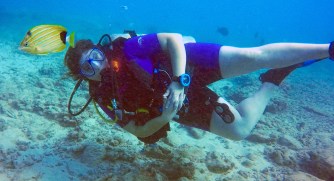
 Scuba diving is the one adventurous thing that I’ve been comfortable with for a long time. I started diving in 2005, and spending time gently floating around reefs or in and around well-prepared wrecks comes naturally to me. I don’t dive a lot, I usually do just one dive trip a year in which I’ll manage somewhere between 4 and 10 dives, so it’s always a little bit scary getting back in the water, but I have enough dives under my belt that I know the drill. Until this last trip, when I decided to do something totally different.
The dive shop that Cliff had used previously on the Big Island of Hawaiʻi, Jack’s Diving Locker, offers a lot of interesting dives, and one that stuck out as really special was their Pelagic Night Dive, which they call “Pelagic Magic” for good reason.
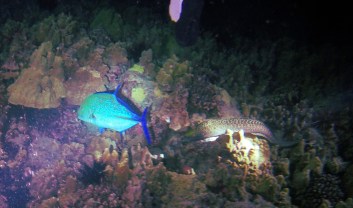
Night dives are always cool, and a little bit scary. There are different fish around, without your light you have no idea where anything is, and it’s very hard to navigate in unfamiliar terrain. With a good guide, though, it’s a great experience and at the end of the day, not that different from a day dive. But that extra adjective, “Pelagic” makes a big difference
Pelagic means relating to the open sea. Most dives, at least for relatively novice divers, happen where the water is 30-100 feet deep, such that your body can tolerate the effects of breathing air at the bottom at least for a short time. Sometimes you’ll dive along a “wall” that may extend well past your maximum depth, but you can look at features on the wall to help guide your descent. Pelagic diving is something different, though – the ocean is thousands of feet deep, so the pressure in your ears and your depth gauge are the only things to tell you how far down you are. So it can get really scary really quickly. Add night diving to the mix, and you basically have no idea where you are.
Not to worry, you are tied to the boat by a line no longer than 50 feet, so as long as you stay attached to that, you can’t get too deep. But you still have to worry about maintaining neutral buoyancy as much as possible so you don’t float up or down too quickly. I spent so much of the hour underwater just getting my bearings and getting comfortable with my buoyancy and my camera. It was simultaneously one of the easiest dives and also one of the most stressful dives I’ve done.
So why do it? Because you get to see things you could never see either in the daytime or on the reef. Things like this “Venus Girdle” – a type of comb jelly (ctenphore) that looks like a ribbon and coils and uncoils itself as it moves through water.
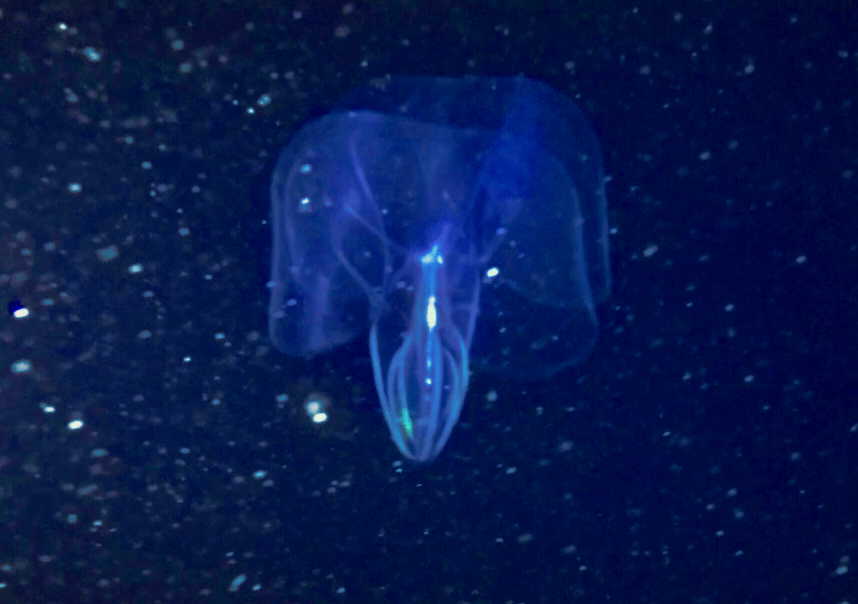
Or this, from a different order of jelly, called a lobate ctenophore:
At night you mostly get to see the juvenile versions, who need the cover of night to rise to the surface to feed without risk of getting eaten by other fish. It’s a beautiful depiction of the food chain at work.
For professional videography compiled from multiple dives, check out this video which puts mine to shame.
I would definitely do this again if presented with the opportunity.
 Do The Things